The pursuit of a long-term dream takes work and persistence, and a whole lot of keeping your eye on the prize. Because of that, we can unknowingly create expectations that are unrealistic – something along the lines of “I can’t wait to finally get there so I can relax and know everything is fine.”
Hooked up and ready for our first RV adventure in 2013.
We’ve all had that feeling. The first time I hopped into an RV for an untimed adventure was in the summer of 2013. I had just closed my pop music school in Keene, NH, which had become a two-migraine-a-week nightmare thanks in part to the housing crash of 2008. I had such high hopes for the changes we were making, which created in me something I call a Destination Mentality. Meaning, on some level I believed that living in the RV would somehow mean I’d reached Nirvana, and all would be well.
Many singers do something similar. I was once asked by a potential adult vocal student, “How long does it take?” I don’t remember my exact response, but I think it may have been something like, “To do what?”
She was asking me how long before she could be a singer, maybe? Or be done working on her singing, maybe? Either way, this question was born of a destination mentality. Each accomplishment in singing and in life can lead you to three more things you’d love to make happen. At least, until you don’t want any of it anymore. Before then, there’s no real graduation.
When you finally get to implement the actual dream part of your dreamy plan, it’s still only one moment along the overall journey of your life. Just like every other day. And just like every other day, you’ll still be affected by your personal challenges and life’s ups and downs.
I hadn’t been thinking that way in 2013. So, when I didn’t immediately feel freer, when I continued to struggle to get to the next place in my career, when Michael and I bickered about stupid things that didn’t matter, I felt like we had failed.
Mistakes were made, the first being that I had succumbed to a destination mentality without realizing it. Another and equally important mistake was that I wasn’t running toward something. I was running away.
But life comes with you.
Change can bring stress and mental fatigue. That’s only a problem if you don’t expect it. If you’re kind to yourself, if you remember and appreciate the changes you’re going through, you can just roll up your pant legs and wade through the changes until the water recedes. And your dream will still be there waiting to unfold with you.
Go after your best life. Starting today. Just never forget that life comes with you.
Judy Fine is a full-time RVer and Vocal, Performance, & Creative Confidence Coach
Got a creative lifestyle dream you’d like to work toward. Consider creative confidence coaching with me. Visit www.voice-your-potential.com to request a free consultation.
After performance anxiety and imposter syndrome, the next top hurdle between many folks and their ability to perform confidently in life is being a social chameleon.
The term social chameleon refers to a person who unconsciously adapts traits, actions, opinions, etc. to fit whatever environment they find themselves in – the way a chameleon changes its colors to fit its environment. Like all traits, there are benefits and drawbacks to being this way. You can both do better in group dynamics than others but lose yourself in a way that they don’t because you’re not being who you are. On top of that, there’s something very important to understand about the social chameleon.
The chameleon isn’t just social.
My backyard garden wedding 1993
I completely wasted my twenties. Not with fun things, like partying too much. I wasted it by being everyone’s perfect chameleon. Sometimes proudly so.
A person wasting her twenties isn’t unusual. The twenties are when we test out our first prototype of the person we think we want to be. We’re working entirely on hypotheses with no actual data to support our suppositions. It’s our first shot at learning who we are.
Part of learning who we are is learning how we fit into the world. Social chameleons fit pretty well, or at least are good at pretending to, because they adapt so easily. But in my twenties, my chameleon also came out in two very important and intimate areas of my life:
My dreams and my relationships.
My chameleon heard a relative say, “But don’t you want to get a real job?” and she thought, “Well a master’s degree could lead to a pretty respectable career. I think I want to go to grad school.” And I did, despite not wanting a “real” job.
My chameleon heard my boyfriend say, “We should get married,” and she thought, “He’ll be so disappointed and hurt if I say no. I guess I want to get married.” And I did, despite not being anything close to ready for marriage.
I was good at fitting in when I wanted to, and this helped me avoid a lot of real-time discomfort. Yet, I repeatedly allowed my adaptation skills to determine the trajectory of my life, which led to much future discomfort. The chameleon taken to this extreme is a kind of performance anxiety. How other people feel about your performance in life becomes more important than how you feel, in part because you fear the discomfort of an audience that won’t clap.
Between my performance anxiety, imposter syndrome, and chameleon tendencies, my twenties became an endless barrage of what my ex-husband would have called revving the gas in neutral. I worked, stressed, and racked up debt for a life I didn’t want. With each chameleon action implemented, I sank a little deeper into a pit of depression and invisibility.
Wow. Sounds pretty bad, huh?
But here’s the amazing part. We each have a person inside us, our real selves. This person knows who we are and what we need. And they are waiting to be set free, one way or another. When I look at pictures of myself from my twenties, I can see that confident person in there, not yet ready to step forward but there. And I feel sympathy for her that she had no one in her life to see what was happening and help her find a way out.
Me, 1991, in the Negev.
She did step forward when the time was right.
It took much more time than is desirable, but I suppose it was inevitable. The outer me had become so numb and broken that the real me sort of leached through to the surface. One day, without knowing it was coming, I heard myself say to my now ex-husband, “I need to take a break.”
That person inside me saved us both. That was the day I hopped off the wrong path and began building the confidence and sense of deservedness necessary to put myself before my audience. That’s the key.
You before your audience.
This is why I do what I do today. Because I want to be for others what I didn’t have for myself.
And here’s an interesting side note. That family member who thought I needed a “real” job ended up clapping for me years later (metaphorically speaking) once I found my way.
Performance anxiety, imposter syndrome, and the chameleon have a way of teaming up and supporting each other as they throw us and our lives off the rails. No matter what measurement of each you see in your life, all three should be managed if they’re there at all.
So, tell me. Do you have chameleon tendencies?
There’s an easy way to check in and see. The next time you’re about to share a thought, idea, or update on your life, etc… ask yourself, “Am I about to say what’s true for me or what I think the person listening wants to hear?”
I promise you, it’s never too late to be who you really are.
My last post was the first in a three-post series discussing three common demons that get in the way between us and our best everyday performances in life. In this post, I want to talk about imposter syndrome. I’ll start by sharing my personal dance with demon number two.
My path toward a life of music started when Boyd Bennett came to visit my kindergarten class to teach us about brass instruments. He and his brother owned the local music school, Bennett Conservatory, in Croton-on-Hudson, NY. At the young age of five, I was already someone who liked things that were different. Because of that, I decided I wanted to play the trombone. It was the only instrument with a slide instead of valves.
Music came easily for me. I had my first live performance at age six, when I played When the Saints Go Marching In on the trombone at a Bennett Conservatory recital.
I so wish I had a picture of that.
Over my school-aged years, I auditioned and got into many all-county and all-state bands, once performing a solo at the beginning of a piece while standing out in front of the orchestra.
While in high school, my middle school music teacher, Mr. Godfrey, would take me with him to the elementary school to help new music students learn to play.
In college, I was a composition student, but my primary instrument was piano. This meant having to pass four piano juries and four composition juries, all critiqued by the appropriate professors in those fields.
I share these details not to impress (or bore) you, but to make an important point that perhaps you can relate to.
Despite these and other successful experiences under my belt, I went out into the world feeling like a complete music imposter.
That’s what people with imposter syndrome do.
“Imposters” routinely discount any accomplishments they’ve achieved or give the credit for their successes to others or outside factors. Imposters overwork to make up for their perceived inadequacies and when their work is well-received, believe that it’s a result of luck or oversight on the part of those giving accolades. And most stressful of all, “imposters” live with a fear of one day being discovered for the frauds they really are.
And so it was for me. It didn’t matter how many musical successes I had, or how quickly I could learn new musical things. In cover bands with musicians who were self-taught and couldn’t speak the language of music theory, I still felt like a fraud.
Now part of this is gender related. Imposter syndrome is enhanced by low expectations and cultural messaging that you “cannot” be good at something. That means it’s a little more prevalent in women and minorities. But it still afflicts more than 70% of all people.
Like every topic in this blog series, there are too many variables to specifically address your personal experience as an “imposter.” As with every personal growth goal, layers have to be peeled away by examining the messaging you grew up with, your past experiences, etc… This is best achieved by working with a coach. But I want to leave you with some tools to think out imposter syndrome, in case you can relate to what I’ve talked about so far.
So, here are some thoughts to consider as you work toward imposter syndrome management:
Talk about it. Since imposter syndrome is so common, you may find that people you feel intimidated by are also experiencing it. Sharing can greatly lighten the emotional load.
Get feedback from someone you trust. The worst feedback isn’t negative feedback. It’s no feedback. For many “imposters,” that gives license to assuming the worst. Positive feedback tells you you’re doing great. Constructive criticism makes it clear how you can do better. Both stop the imposter mind from messing with you.
Out your secret shame. Think of an event or events that took place in your past, possibly something you’ve labeled a “failure,” that you have up until now not wanted others to know about. It should be something that flares your imposter’s shame and that you’ve viewed as proof you’re a fraud. If something comes to mind, out yourself about it. Tell someone or many people. You’ll find that it doesn’t define you the way you thought it did (meaning, other people won’t care) and it will lose its power over you.
Living with imposter syndrome can be exhausting and painful. Learn to manage it however you can. Let me know your thoughts…
This post is the first in a three-post series, covering the most prevalent culprits that stand between people and their best-performing selves. I have dealt with all three to varying degrees and at various times in my life. So have many others, maybe including you. They are performance anxiety, imposter syndrome, and the social chameleon.
For now, I want to talk about performance anxiety, since it is the mother of all demons standing between you and your best everyday performances.
And notice I say everyday performances. Not just artistic or business presentations. I’ll tell you what I mean by that, but first, a little about my dance with this demon.
When I was a kid, a had a crappy little tape recorder. Yes. That’s how old I am. I loved singing in my bedroom and had a rich fantasy life where I owned a theater that produced musicals using the latest pop hits. I’d listen to the radio and when each next hit from one of my “musicals” came on, I would “practice” that “scene.”
One day, I decided I wanted to record myself singing one of these songs on my crappy little recorder. I practiced the song over and over again until I felt ready. Then I hit record. Immediately, my throat clenched up, my voice squeaked, and I could no longer remember the words.
Welcome to the world of performance anxiety.
Nothing changed regarding my ability when I hit that button. All that changed was the knowledge that I was being recorded. It triggered my fear of stinking at things that are important to me.
So what, if you didn’t like it? you may ask. Couldn’t you just delete it and try again?
Well, sure. That’s logical. But anxiety isn’t. Besides, it wasn’t just a fear of other people thinking I stink at singing. It was a fear of me finding out I stink at singing. A recording would be proof!
Now, if you’re saying to yourself, “This has nothing to do with me. I’m not a singer,” hang in there. I’m getting to you…
This performance anxiety followed me into my musical adulthood. There’s no nice way to describe it. As a singer and keyboardist in the cover band world, my performance anxiety made me an asshole to myself.
For days leading up to a gig, I was an impatient stress-case who hated how I looked and who was getting a cold. I mean it. I got a cold every time. I wasn’t faking it. The symptoms really came.
At my early performances, I would start the first set being the semblance of a normal performer. But with each little mistake, which to me were all huge and boldly telegraphed to the room, I would turn down the volume on my keyboard. Some nights, I’m not sure anyone could hear me at all by the end of the third set. Then I’d go home, and instead of sleeping, I’d rehash all the ways I had been inadequate at the gig.
See? I was an asshole.
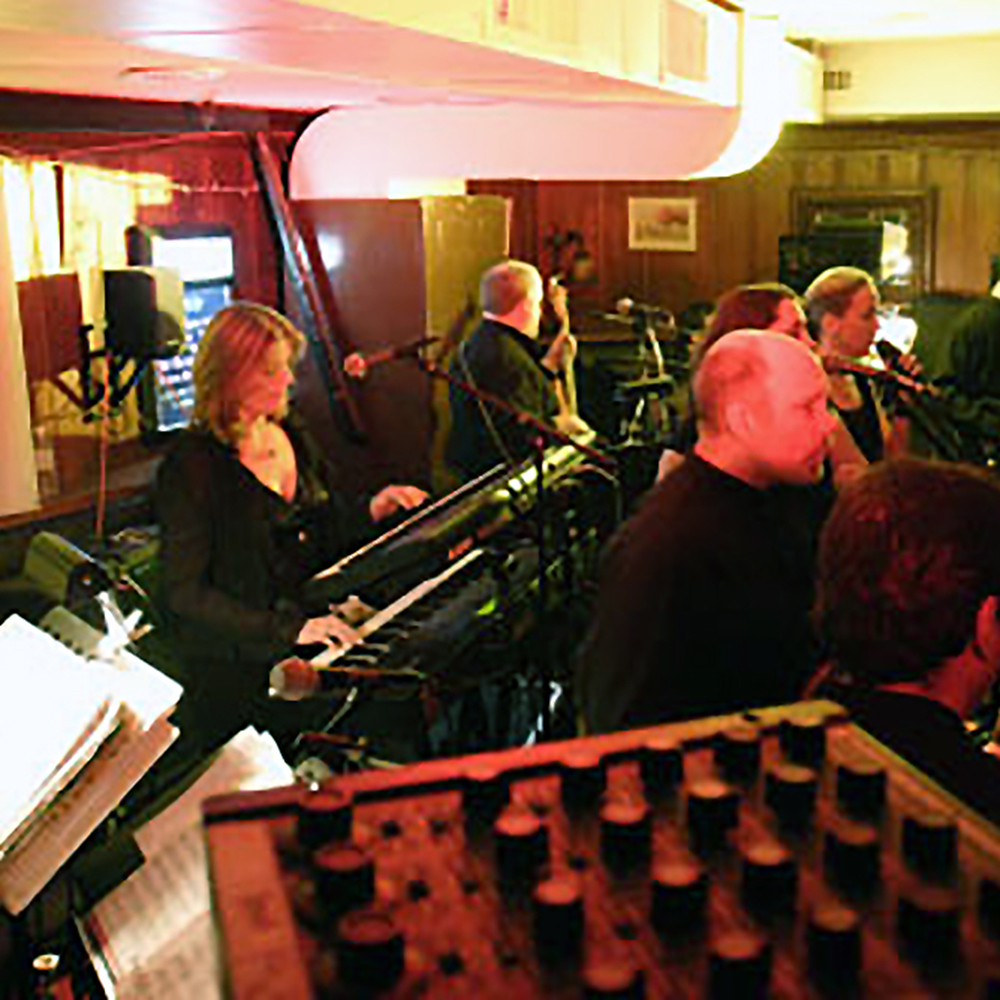
Circa 2003 playing keys in Brattleboro, VT.
Honestly, I don’t know why I kept gigging. But fortunately, I did. And over time, I learned to work through it all. I promise anyone reading this that you, too, can learn to work through it (even if you’re not a singer – still getting to you!). The things I learned to help myself manage that anxiety became the methods and tools I use to coach others to more confident performances today.
But how does all this pertain to you? Especially if you’re not a performer (finally, we’re here!)?
All the world’s a stage. So said Shakespeare, anyway, and he was right. But it’s not just that we’re born, play our role, and then make an exit. It’s because most everything we do is a performance. Giving a speech. Being interviewed for a job. Asking someone on a date. Saying how we really feel when we know it’ll disappoint someone. These are all kinds of performances.
As with music, I struggled with everyday performances like these well into my thirties. Believe it or not, the music performances were sometimes easier to deal with. After all, they were rehearsed, and I had tools on stage (aka, cheat sheets) when I needed. But put me in a real-time situation where I needed to tell someone intimidating what I charged, or a guy I was dating that I wasn’t that into him, and I really struggled. No lie, I went on quite a few dates I didn’t want to go on because I couldn’t just say, “Yeah, no. Thanks.” And these are the small but oh so important things that a life is made up of. If you rack up enough of these seemingly inconsequential moments, it becomes a whole lot of not my life.
The majority of the most important performances in our lives barely register as a thing. And most are unscripted.
Imagine being out to dinner with a friend and she runs into someone big in the field you’re trying to break into. She introduces you. Lights, camera, action!
Or you find yourself in a situation where you need to stand up for yourself. Or set a boundary with a loved one. Or correct an important misunderstanding about something that happened at work. All of these are important everyday performances where you want to keep your head and communicate clearly and concisely. People with performance anxiety can struggle with any of these situations.
If everything is a performance, you may ask, why doesn’t everything I do trigger my performance anxiety?
That’s a great question. Thanks for asking! Something has to be at stake. Your reputation. Your self-worth. Your emotional or physical safety. Something important to you must be at risk.
If this resonates with you, the natural next question is, “What do I do about it?”
Improved performance skills don’t come about from reading one blog post. They develop over time as you practice performing. One way to accomplish that is to join forces with an experienced performance coach (I can recommend one!).
Meanwhile, below are some tips to get you started in the right direction whether or not you go the performance coach route. Start incorporating them into your everyday performances, and you’ll watch those performances become better and better.
Confident performance always begins with the messages your body is sending to both your brain and your audience. Control the messages by relaxing your shoulders, slowing down, breathing deep, cracking a smile, if it’s appropriate. Basically, hold your body the way you would if you were feeling relaxed and confident.
When your mind goes to a place of panic, ground yourself. Noticing your points of contact is the fastest way to do this. How do your feet feel against the floor? How does your bottom and back feel against your chair? Grounding yourself will hold you in the present.
Jettison any concern about the other person or people liking you. Even at a job interview, the only thing that matters is communicating your message. How it’s received is out of your hands, and wasting valuable mental energy worrying about that detracts from the power of your message. Focus on the message, not their feelings.
Similarly, don’t put too much stock into any performance. Your life never hinges on any one performance. I swear.
Don’t sugarcoat, pad, or apologize for your viewpoint. All of those things come across as wavering and uncertainty. Just say what you mean without disclaimers or too much explanation.
Approach any everyday performance as an opportunity to practice performing better. Performance is a skill that needs to be practiced, like every other skill. Note what went well and what needed improving and then apply that information to your next performance.
There is so much more to confidently executing your everyday performances. For example, to unabashedly speak your truth, you have to get clear about what your truth is. But that’s for another post. Meanwhile, I hope these tips help. Break a leg!
For a while now, there’s been a growing financial divide in the United States. On one side of this abyss folks are getting wealthier and wealthier. On the other side, it’s been harder and harder to live a financially secure and peaceful life. There are many political, social, and moral reasons for this, none of which I’m about to go into.
Instead, I want to talk about how those on the wrong side of the abyss can choose to navigate this world of inequity – how to get your fair share of security, satisfaction, and freedom. It involves one simple concept.
Stop playing their game.
Our travel-trailer home.
I’m a fulltime RVer. In my online perusing, as I researched what it might be like to live on the road, I came across many nomads giving advice along the lines of “Just do it! Sell your house and live your dream!”
Please don’t do this.
I’m all for dream-chasing. It’s what I coach others to do. But I want my clients to do it successfully. “Just doing it” isn’t a plan, and if it was, it sure wouldn’t be the first step. I already told you the first step.
Stop playing their game.
Who is “they” in this advice? I’m actually referring to three groups of people.
Definition 1: The dysfunctional voices in your head. Whether you were taught certain things about life or about yourself, or whether these things were modeled for you, we all have beliefs and assumptions that guide our every move. Not always for the better. Maybe you believe you’ll never have a lot of money. Maybe you believe that life should be hard, and if it isn’t then you don’t deserve good things. Maybe you believe you’re an imposter who has nothing of value to share with the world. If you don’t deal with these kinds of voices in your head, the minute something goes awry on your path, they will begin to scream and you will doubt yourself. They can make you quit, when all you needed was a slight trajectory adjustment. Many a dream has been killed this way. Shine a light on the voices and change the narrative. Stop playing their game.
Definition 2: Restaurants, Banks, and Shiny Objects. How do the haves keep the have-nots on the wrong side of the abyss? By keeping us in debt. Except we do it to ourselves. You can’t have a financially secure future without taking control of your finances today. If you keep upgrading your phone when you don’t need to, if you get into auto loans you can barely pay on, if you keep buying things on credit cards and making small payments toward them each month, and if you’re doing all this without putting money into savings and an emergency fund each month, you are playing their game. And you’re the loser, because the house always wins. If we stay in debt, we have to keep shitty jobs and bad working conditions because we have no choice. And if we don’t create our own safety nets to survive difficult times, we won’t survive difficult times. Stop playing their game and take charge of your financial life.
Definition 3: Those who fear risk. We creative box-hopping types scare some people. Generally, these are people who love us. But our career choices make them concerned, and our scary (to them) dreams make them downright anxious. They want to talk you out of those choices so they can feel more comfortable. But you can’t build a life based on what makes someone else comfortable. Incidentally, a great map that includes sound finances and good logistical planning would ease their concerns. But their concerns can’t be your concern. This is your life. Stop playing their game and start living it.
View of the intercoastal waterway from our RV park in Myrtle Beach, SC.
We knew we wanted to RV fulltime but we didn’t want to workamp.
Michael and I decided to embrace a mobile lifestyle because we wanted to simplify our lives and stop feeling married to a job and a mortgage payment. One way RVers finance life on the road is by workamping, meaning they get jobs in various parks that give you a place to park your rig while you work. Now, lots of folks do this kind of work and they love it. But to us, having to sort out from season to season where we’d get our income from next was a similar kind of pressure to the pressures we wanted to leave behind when we sold our house. It wasn’t for us.
What do you dream of jumping into, and how can I convince you to put some time into planning it out?
Yes, we live on the road today, but we spent nearly three years getting ready for the change. The primary challenges involved:
Getting rid of unnecessary debt and fattening up our emergency fund.
Transforming my mostly in-person business to an all-online business.
Trust me, we wanted to jump in and just do it, like many YouTube influencers tried to tell us. And maybe there’s something you’re itching to jump into right now. But if an outcome is really important to you, starting before you’re ready to be successful is too big a risk, isn’t it? If you jump before you know where you’re going and how you’ll get there, you may find yourself back to playing their game.
One option I offer you right now is to reach out to me and setup a free consult. It’s just a conversation about what you want to achieve and what’s getting in your way. There’s no obligation to become a coaching client. But use me as a sounding board to help you uncover the next step, whatever it is for you.
Whether you take advantage of a free consult or not, start drawing your roadmap today. Your life tomorrow will be worth it!
Agree? Disagree? Let me know.
Judy Fine
Full-time RVer and Vocal, Performance, & Creative Confidence Coach
Got a creative lifestyle dream you’d like to work toward. Consider creative confidence coaching with me. Visit www.voice-your-potential.com to request a free consultation.
As a creative confidence coach, and as a person, I’ve always lingered between worlds. I have a Master of Music but an aversion to music academia. I eat a lot of meat-free and dairy-free meals but I’m not a vegan. I have what you might call a spiritual approach to life but I’m an atheist.
Jazz and I in front of our home, a 29ft Lance travel trailer.
There are very few categories I neatly fit into. I’ve lived my life outside the box, but the box was always right there. It’s more like I hop inside when it’s appropriate and hop out when I please.
I’m what I like to call a box-hopper.
Maybe that’s why I’m so comfortable being a creative confidence coach. I get to become a bridge for others between their normal lives and the custom-fit lives they dream of living. It’s just a box, after all. They’re not so hard to bust open.
You may not consider yourself box-hopping material. Maybe you like your 9 to 5 life and the stability and structure it provides. But if there’s some way you dream of tweaking life so that you can experience more joy and fulfillment, and you tell yourself you can’t, then you live inside a box of your own making. And you can find ways to hop out of that box from time to time without completely leaving it behind. That’s literally what a box-hopper does.
It used to be considered a financial death sentence to live life the way you want. I’ve heard many an artist declare acceptance that they will never make a lot of money because they choose to follow their artistic passion. You know, because you can’t be a musician or artist and be financially sound.
Get in the box or get out.
Same goes for full-time RVing. There is this idea that either you’re wealthy or you buy a crusty old van to live in and shower twice a month, if you’re lucky.
Get in the box or get out.
These constitute Bullshit Stories. Confidence coaches hear them often. I’m sure you’ve heard them, too, perhaps sometimes coming from your own mouth!
My RV office.
“I can’t pursue my passions because I have children,” would be a bullshit story. “One of us has to be realistic!” is another. Or here’s a good one, “I’m too old to follow my dreams.”
There is no reason why you can’t be a box-hopper starting today. There’s only one trick to doing it successfully and sustainably. Planning.
That’s what I help others do as a creative confidence coach. I help them build the confidence to be and live as they really are, in the box, out of the box, or while box-hopping.
When Michael and I decided we wanted to become fulltime RVers, we were neither wealthy nor willing to accept the crusty-old-van version of nomad life. So, I became my own coaching client and we made a plan. It took three years and was tweaked and updated often during that time, and now we’re doing it.
Wherever you are today, you can also make a plan to build your best life, whatever that means for you.
Here are some great questions to get the ball rolling.
What thing(s) do you wish you could add or grow in your life that you’ve been telling yourself you can’t.
What are the obstacles or challenges you perceive (and are they real or only feared)?
What are your options for dealing with or bypassing these challenges?
What aspects of your current life would need to change or go away to successfully implement this new aspect you dream of?
What new skills, knowledge, or circumstances would your need to build for success?
Who are you most afraid of disappointing, if anyone? And:
What would happen if you disappointed them?
Are you willing to live with their disappointment for the sake of pursuing your best life?
Are you ready to practice saying the following statement? “This is totally possible. I just have to navigate it!”
I’d love to hear your answers to these questions and your thoughts on the entire topic.
Judy Fine
Full-time RVer and Vocal, Performance, & Creative Confidence Coach
Got a creative lifestyle dream you’d like to work toward. Consider creative confidence coaching with me. Visit www.voice-your-potential.com to request a free consultation.
Everyone experiences it to some degree. We know it as it's happening. You're about to go on stage and your palms are sweaty, your heart is racing, maybe your throat is clenching up and you feel nauseous. These are examples of symptoms that are obvious and recognizable.
But are there signs of performance anxiety that you're missing? Keep reading to find out, because if you're misreading the cause of a problem, you are likely not properly addressing the fix.
Before we get to the signs of performance anxiety that you could be missing, let's talk more about what we mean when we say performance.
A singing performance is an obvious example. Speech-giving is another event that commonly activates performance anxiety. But these are only two of many forms of performance. How many? I can't even tell you, because just about everything is a kind of performance. Some examples:
Going on a job interview
Asking someone on a date
Expressing your opinion among a group of different-minded people
Raising your hand to answer a tough question in class
Leading a team project at work
If you struggle with performance anxiety as it relates to singing, there's a good chance that the same anxiety creeps into other aspects of your life. This is why I broach this topic with my students over and over again. Learning how to manage performance anxiety is an important life skill, not just a singer's problem.
Different people land at different spots along the anxiety spectrum but if you struggle to any extent, the information here will be helpful to you.
The effects of performance anxiety can be broken into two categories:
Real-time effects. The physical, emotional, and mental reactions experienced at the moment, or just before the moment a performance begins.
Preemptive effects. The physical, emotional, and behavioral reactions to an impending (or even considered) performance.
Since most folks recognize the real-time effects of anxiety, I'm going to focus here on preemptive responses.
A definition of Preemptive: "Serving or intended to preempt or forestall something, especially to prevent attack by disabling the enemy."
This is what part of your subconscious is attempting to do. It views your planned performance as a kind of attack on your wellbeing and wants to "disable the enemy" (you) to prevent the perceived threat (the performance).
Your subconscious knows your weaknesses.
If you're someone who frequently gets migraines, you may find yourself coming down with one a day or two before a performance. If you're prone to depression or extreme overwhelm, then you'll probably experience those things instead. My Achilles' heal is congestion. Before I understood the workings of performance anxiety, I frequently came down with cold symptoms before a performance. And they would magically go away when the performance was over.
Moodiness is another preemptive symptom of performance anxiety. Impatience and arguing can increase. People may become frustrated, negative, and downright mean to others and/or to themselves.
Below is a presentation about performance anxiety that covers the phenomenon from start to finish.
I've shared this before, but if you haven't seen it yet and you struggle with performance anxiety, please watch it. In it, I describe the greatest tool you possess for lowering performance stress and improving assertiveness. It's the knowledge that will empower you to continue following your passion successfully.
Click to play
Two important things to move beyond your performance anxiety.
1. You have to practice performing.
You need to practice the advice I give in the presentation above regarding how to hold your body. You have to practice not completely losing your mind as you perform. And you have to rack up "wins" so that the part of your subconscious that is trying to protect you learns that protection isn't necessary. You can do this in stages:
Allow yourself to be imperfect as you work to improve.
If a performance doesn't go the way you want, take note of what you'd like to change and try again.
Don't take life too seriously. You're allowed to evolve over time like the rest of us.
2. Find support in people who get your fears.
Friends, family, and/or colleagues are ready to be there for you. If you want more experienced feedback, schedule a chat with me. No high pressure sales. I'll be your friendly sounding board.
The subject of performance anxiety often appears in my posts and videos. That’s because I had a severe case myself when I was younger, and it became paramount that I figure out how to move beyond it. I know I’m not alone. Most of us experience this kind of anxiety, at least to some degree.
But this isn’t a challenge exclusive to singers because pretty much everything we do is a performance. Job interviews. Running team meetings. Asking someone out on a date. If you struggle with public singing or speech-giving, there’s a good chance you struggle with these other types of everyday performances.
Overcoming performance anxiety is beneficial to everyone. The tools to improve your ability to get on a stage without completely losing your mind, are the same tools you can use to perform better and with less stress in other areas of your life.
I put together the following video presentation to answer three questions:
How does performance anxiety manifest?
Why does performance anxiety happen?
How can I conquer performance anxiety?
The answers to these questions changed my performing life. I feel certain they will do the same for you. Let me know if you think I left anything out. Enjoy!
(PS: Please ignore references to Patreon. That was old Judy.)
Well, I take that back. Performance anxiety IS for performers, but we are all performers. Asking your boss for a raise is a kind of performance. Dealing with a difficult family member is a kind of performance. Saying what you really think in a group of potential “disagreers” is a kind of performance.
We are all performers, sometimes on a daily basis. If you leave important gatherings kicking yourself for the good point you couldn’t bring yourself to add, you’re not weak or broken. You have performance anxiety.
And you are in no way alone.
The single most common thing I hear from my voice students is, “But I did it so well at home. Why can’t I do it here?” The answer is, because performance anxiety is literally a part of our nature.
So, what is performance anxiety?
Well, the symptoms can range from sweaty palms to dry throats to severe diarrhea and more. I have heard stories of dancers moving off stage during a show, throwing up in a bucket and then returning to the stage for the next scene.
I remember a boy in my 7th grade English class who, after finishing the last presentation of the class, waited behind the podium for the rest of us students to leave the room because he had peed in his pants and didn’t want us to know. Poor kid.
Many, many famous people have struggled with severe anxiety, Vladimir Horowitz, Barbara Streisand and Adele, just to name a few.
Why does performance anxiety happen?
It may seem like a kind of punishment or weakness when you really, really want to do something and your anxiety gets in the way. It isn’t. It’s actually a built-in mechanism designed as a safeguard. It’s part of the fight-or-flight response and it has been protecting your genes for millions of years.
Fight-or-flight is a physiological reaction to a perceived threat to survival.
It may seem silly on the surface, since singing a song at open mic night will not kill you no matter how badly it goes. But fight-or-flight is more complicated than that. The thing to recognize is, it isn’t really about your survival. It’s about the survival of your genes. Your genes only survive one way, by you convincing another that you are a suitable mate. And the better the mate (the stronger, healthier, more talented, more connected) the better chance of survival for those who will carry your genes into the future. That’s a lot of pressure!
In evolutionary terms, that means being approved of and accepted by your peers (it’s safer to be part of a tribe) and obtaining or maintaining a certain status (to draw a “better” mate) are of primary importance, at least on a powerful genetic level. To your genes, every performance is a potential fight for survival. That’s why someone like Vladmir Horowitz, considered one of the best pianists in the world, can feel more and more anxiety as he becomes more and more acclaimed. Because there is a higher and higher status to risk losing.
Why do I want you to know all this?
I want you to remember not to be fooled by the tricks of your subconscious. I want you to see that feeling weak or stupid or scared is in actuality playing into the hands of your subconscious (if it had hands). You are falling for the deception if you let those thoughts stop you from accomplishing what you want to accomplish. Knowledge is the only weapon against deception. Now you have more of it.
Great. You’ve gained new perspective on a root cause of performance anxiety. But you still experience Montezuma’s Revenge before every staff meeting you run. So, now what? Well, now that you’re privy to the motivation and deceptive nature of your subconscious, you’re ready to move on to the eight steps to improving your performance skills. But they must be backed by a determination to not let the fears of your subconscious trick you and stop you from moving forward. Here they are…
8 Steps Away from Performance Anxiety.
Be prepared. Be very prepared. Remember, whatever your performance may be, your subconscious is a big wussy and doesn’t want you to do it. It will attempt to prove itself right by undermining your success, so you won’t want to do it again. It will say things like, “What’s the point in practicing? You’re going to fall on your face anyway.” Or, “You should go over your notes but the couch looks so soft and you’re so very tired.” Don’t listen. The more you know your topic, your lyrics, your reasoning, the better you’ll be able to recall them when your nerves are acting up.
Practice. Don’t confuse this with being prepared. When I still had my music school in NH the school year was 34 weeks long, during which time we would have three student gigs. That meant that each year my students had 34 opportunities to practice practicing and 3 opportunities to practice performing. Performance is its own skill that you have to practice to be good at. Find opportunities to perform while under pressure, like maybe in front of a group of friends or family members (and see number 6 for another way).
Hold your body like a confident, relaxed person. Yes, thoughts influence our bodies but it works the other way too. If you body is tense, your heart rate is up, if you’re moving around quickly, never smiling, etc… your brain will take inventory of all this and draw the conclusion that you are scared, stressed, whatever. If you stand tall, walk and talk slowly, relax your shoulders, smile, laugh, you will convince your brain that all is fine and your brain will then convince you.
Don’t say that you’re nervous. Not before, during or after a performance. You’re training your body and brain to be better at performing. You need to convince both that performance is something you’re not afraid of. I am known for telling my students that they are not allowed to say, “I’m nervous.” They must instead say, “I’m excited,” even if they don’t think they mean it. Physiologically, excitement and fear are very similar, but excitement has a much more positive impact and can retrain your brain with a new and better attitude.
Visualize greatness. Did you know that your subconscious mind cannot differentiate between an actual experience and an imagined one? For example, when you imagine lifting your leg, it stimulates the same parts of the brain as when you actually lift your leg. That means that you have almost endless opportunities to practice performing, in your mind. The trick is to do it in strict detail. As an example, last practice for an open-mic performance:
You imagine yourself walking into the café where the open mic is going to happen. You can smell coffee brewing. You smile confidently as you see the crowd of people waiting for the music to begin. That’s a lot of people to share your beautiful lyrics with.
You slowly walk to the counter to order a drink. Then you find a seat and pull out your guitar to tune it while you joke confidently with another singer waiting to perform. You tell the other singer that you can’t wait to get up there.
You hear your name being called and walk to the stage. You say hello with a smile, feeling completely relaxed and confident.
Then you start your song and sing it from beginning to end, flawlessly, nailing the high note at the end just the way you want to.
You smile and soak up the crowd’s applause. You thank them and go back to your seat.
If you do this three times before the show, the show will be your fourth performance and you’ll do great!
Expect a “bad” performance here and there. If you want to be able to do something really well tomorrow that you can’t do today, you’re going to have to go through a period of time when you do it and it’s not that great. That’s just the way it is. No one moves directly from inability to mastery, so stop expecting to. Lingering over past snafus quickly becomes an excuse to stop trying (which that wussy subconscious of yours wants you to do). Keep your eye on the prize. It’s really not that far away–unless you give up.
Remember, it just ain’t that important. Did you have a “bad” performance? Did the woman you asked out turn you down? Did your job interview go badly? Get over it, and I mean that in the most compassionate of ways. Move on and work to do better next time. You’ll live. This is your world as much as anyone else’s. You have the right to be imperfect while on the road to greatness. If anyone treats you otherwise, Forget Them. You get one shot at this life and it goes pretty quickly. Don’t waste any time feeling like you answer to anyone else. Answer to you.

 Hooked up and ready for our first RV adventure in 2013.