

You're scrolling through Instagram at 2 a.m., looking at paintings by some 23-year-old who's already had three gallery shows. Or maybe you're watching a YouTube video of a teenage pianist whose fingers move like water over the keys. And you think: I'm 47. I've always wanted to do something like that. But isn't it too late?
Here's the truth that no one seems to say out loud: the question "Is it too late?" is almost never really about time.
The Prodigy Myth Is Ruining Everything
We've been sold a story about creativity that goes something like this: real artists, real musicians, real writers start young. Mozart composed at five. Picasso painted before he could read. If you haven't shown signs of genius by age twelve, you've missed your window.
This narrative is so pervasive that it's become invisible. We see it in the way music competitions have age cutoffs. In the way art school applications emphasize "emerging" talent. In the breathless media coverage of teenage prodigies that makes starting creativity later in life seem like a consolation prize rather than a valid path.
But here's what that story leaves out: for every Mozart, there are thousands of artists who found their voice at 40, 50, 60, or beyond. We just don't hear about them because "Woman Discovers Love of Watercolor at 53" doesn't make headlines the way "12-Year-Old Prodigy" does.
The prodigy myth doesn't just make us feel inadequate. It fundamentally misrepresents how creativity actually works.
Creativity isn't a gift bestowed upon the chosen few in childhood. It's a practice, a skill, a way of seeing that can be developed at any stage of life. And sometimes, starting later comes with advantages that no amount of early training can provide.
Your Brain Is More Capable Than You Think

Let's talk about neuroplasticity, because this is where science becomes genuinely encouraging for anyone worried about beginning creativity at 40, 50, 60, or beyond.
For decades, neuroscientists believed that the adult brain was essentially fixed. You got the brain you had by your mid-twenties, and after that, you were just playing out the hand you'd been dealt. This belief quietly supported the idea that midlife creative pursuits were a waste of time.
Turns out, that belief was completely wrong.
Modern neuroscience research has revealed that the adult brain remains remarkably plastic throughout life. Your brain continues to form new neural connections, grow new neurons in certain regions, and reorganize itself in response to learning and experience well into old age. When you learn to paint at 55, your brain physically changes. When you pick up the guitar at 62, new pathways form.
Studies have found that adult brains learning new skills show similar patterns of neural growth as younger brains, just through slightly different mechanisms. The adult brain may take longer to encode certain types of information, but it compensates with better pattern recognition, deeper contextual understanding, and more sophisticated integration of new knowledge with existing experience.
In other words, adult creativity doesn't work worse than youthful creativity. It works differently, often drawing on a richer well of life experience and developed judgment that younger creators simply don't have yet.
The research on too-old-to-be-creative worries? It doesn't support them. What the science actually shows is that creative capacity doesn't decline with age nearly as much as we've been taught to believe. What does decline, if we let it, is our willingness to try new things and risk being a beginner.
Real People Who Started Later (Not Celebrity Stories)
You've probably heard the famous examples. Laura Ingalls Wilder didn't publish her first book until she was 64. Grandma Moses started painting in her late seventies. These stories are inspiring, but they can also feel distant, like exceptions to the rule.
So let me tell you about some people whose stories you haven't heard.
There's Marcus, a mechanical engineer who started taking pottery classes at 51 after his divorce. He'd never made art before, never even considered himself creative. The first three months, everything he made was lopsided or cracked in the kiln. Five years later, he was selling his work at local craft fairs and said the practice of working with clay taught him more about patience and presence than twenty years of therapy ever did.
There's Jennifer, who picked up singing at 43, after her youngest child left for college. She practiced in the early mornings before work, and yes, initially sounded like a beginner. She'll probably never perform at Carnegie Hall. But she became a staple in her local karaoke circuit, and she says it has given her a sense of joy she didn't know was missing from her life.
There's Robert, who started writing poetry at 67, a year after his wife died. He'd been a accountant his whole career, dealt in numbers and certainty. Poetry gave him a language for grief and, eventually, for everything else. He's never tried to publish. The writing itself was enough Return On Investment.
These aren't stories of late-blooming genius. They're stories of ordinary people who decided that starting creativity later in life was worthwhile regardless of outcome. They're stories that prove the question isn't "Am I too old?" but "Do I want this enough to be willing to be bad at it for a while?"
The Surprising Advantages of Starting Creative Work in Midlife
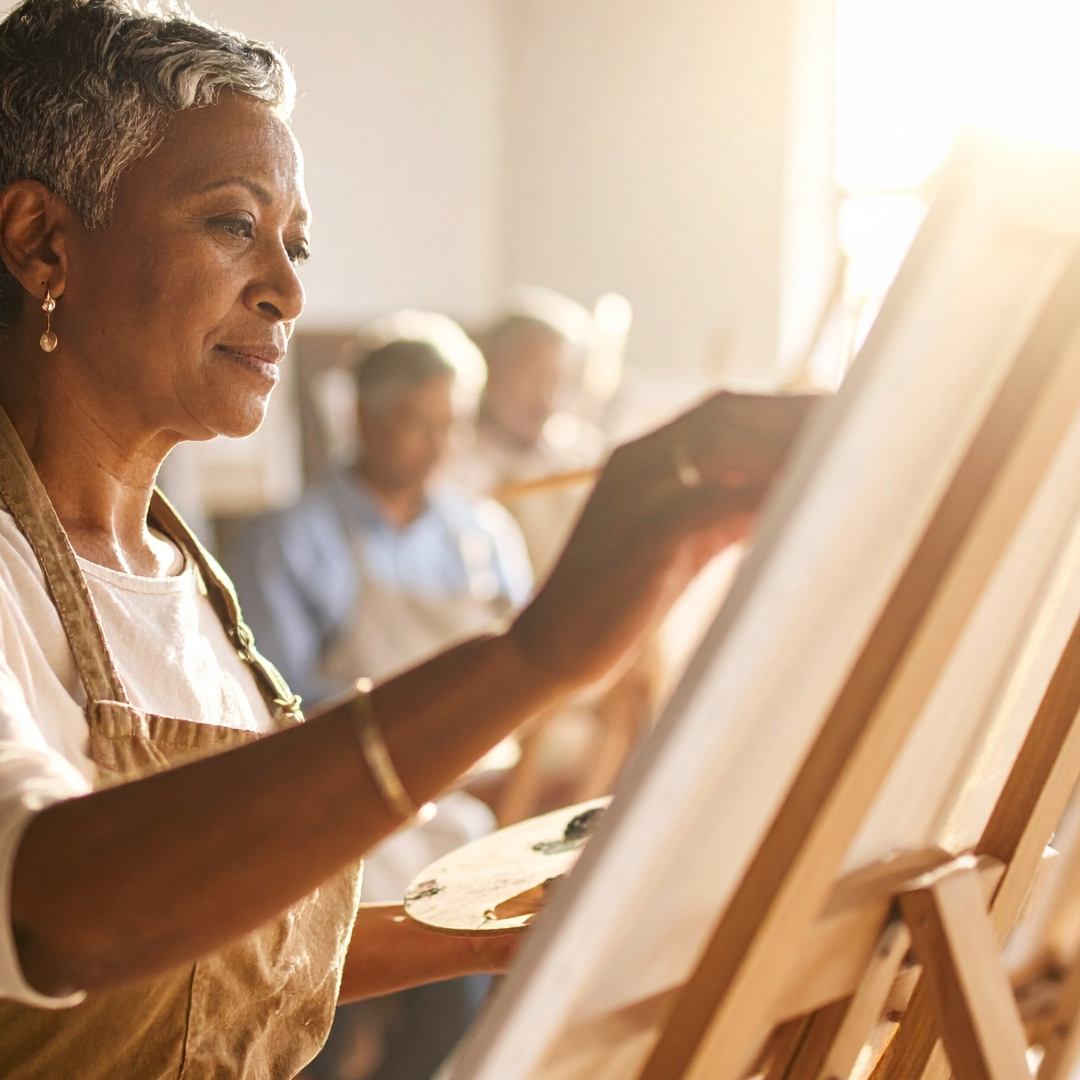
Here's something that doesn't get said enough...
Beginning creativity at 40, 50, or 60 comes with genuine advantages.
First, you have perspective. You've lived enough life to have something to say, something to express.
A 25-year-old painter might have technical skill, but a 55-year-old painter who just started has decades of emotional experience, joy, loss, complexity to draw from. That depth shows up in the work, even in the early, technically imperfect work.
Second, you're less concerned with external validation. When you're young, so much of creative pursuit gets tangled up with questions of career and identity and proving yourself. At midlife, you have the freedom to make art just because you want to. You're less likely to abandon a creative practice because you're not immediately brilliant at it. You've already built a life. This is extra.
Third, you have resources that younger creators don't. You might have more financial stability to take a class or buy materials. You might have more control over your time. You certainly have better-developed executive function skills to actually maintain a practice rather than just dreaming about it.
Fourth, you've already failed at things. This sounds depressing, but it's actually liberating. You know that failure isn't fatal. You know that being bad at something temporarily doesn't mean you can't get better. You've developed resilience that makes the vulnerable work of creating something new less terrifying.
The unique advantages of starting creative work in midlife aren't about making up for lost time. They're about approaching creativity with a maturity and purpose that early starters often have to develop later in their journey.
What "Too Late" Really Means
When you say "I'm too old to start painting," what you usually mean is something else entirely.
Sometimes "too late" means "I'm afraid I won't be good at this." The fear isn't about age. It's about ego, about the vulnerability of being a beginner when you're accomplished in other areas of life. It's hard to pick up a paintbrush for the first time when you're used to being competent and respected in your field.
Sometimes "too late" means "I don't want to waste time on something that won't lead anywhere." This reveals an assumption that creative pursuits are only valuable if they result in career success or public recognition. But what if making something beautiful or meaningful is enough, even if no one else ever sees it?
Sometimes "too late" means "I've already missed my chance at the life I wanted." This is grief, not logistics. The sadness isn't about adult learning or midlife creative pursuits. It's about mourning the path you didn't take when you were younger. That's real, and it deserves acknowledgment. But mourning one path doesn't mean all others are closed.
And sometimes, honestly, "too late" is just fear dressed up as practicality. It's a way to protect yourself from the risk of trying and failing, of wanting something and not achieving it, of being seen as foolish or delusional.
The hard truth? None of these fears go away just because you're young. A 22-year-old starting to paint is also afraid of being bad at it, of wasting time, of looking foolish. They just don't have "I'm too old" as a convenient excuse to not try.
So, Is It Too Late?
No. But also, that's the wrong question.
The right question is: "Do I want to spend some of my remaining time on this planet pursuing something my heart wants?" If the answer is yes, then you start. Not because you're going to be great at it, not because it's going to lead somewhere, but because the alternative is spending the rest of your life wondering what it would have been like.
You're not too old to start painting. You're not too old to learn piano. You're not too old to write poetry, throw pottery, learn photography, take up woodworking, or do any other creative thing that calls to you.
You are exactly the right age to be a beginner at something new.
Time is going to pass whether you pick up that paintbrush or not. Whether you start learning guitar today or talk yourself out of it, you will still be 52 next year. The only difference is whether you'll be 52 with a year of creative practice behind you or 52 still wondering if you're too old to start.
The best time to start was twenty years ago. The second best time is now.
So ask yourself: what creative pursuit keeps tugging at your sleeve? What would you try if you knew you couldn't fail, or better yet, if you knew failure was just part of the process?
Whatever it is, start there. Start small. Start messy. Start scared.
Just start.